|
In the middle
of the 19th century, it became clear that there was a requirement for
an Anglican church and vicarage to serve the needs of the growing
Anglican community in Sliema. In response to an appeal for funds
by the Bishop of Gibraltar, the Rt Rev Dr Walter John Trower, two
well-known English merchants of the time, Mr Ingham and Mr Whitaker,
each donated £100 to add to the Bishop's promised gift of
£1000.
The total estimated building cost for the Church was £4000. The
Bishop therefore undertook to be responsible for the remainder, to be
provided as building progressed.
On 7th April 1866, the villa known as the Bishop’s House and the
adjoining land on which the church was to be built was acquired by the
Bishop’s daughter, Miss Jane Trower. Her intention was to
transfer the property to the Episcopal See of Gibraltar. However, under
the law, an unmarried woman, in the lifetime of her father, could not
make a donation of greater than £50 without his consent. Thus the
Bishop became party to the Deed of Gift and also refunded to his
daughter the purchase price of £1,050.
In the early years, a Sliema Church Endowment Fund was inaugurated by
Bishop Trower with a sum of £100, increased in 1871 by his
successor The Rev’d Charles Amyand Harris, with a gift of
£2,000. The interest that this amount generated paid stipend to
the incumbent Minister of £72 annually. The money generated from
the offertory, after expenses had been deducted further increased this.
The Chaplains residence, known since 1905 as Bishop’s House, was
built in 1855. Memorials and gifts in Holy Trinity Church reflect its
military and civilian connections.
A Guided Tour:
The design of this Church is unusual in Malta; it was built for the
English community and so reflects the shape of a village Church
anywhere in the United Kingdom. The high pitched roof and simple
two stage shape do focus our attention on looking up and beyond
ourselves as we approach. The narrow, pointed East windows with
their highly coloured roundels soar upwards in a similar vein.
The delicate tracery of the chancel screen both highlights the holiness
of the place but at the same time allows entrance and does not obscure
what takes place at the altar.
Anglicans on Malta
British people began settling on Malta in the early 1800’s as
traders, civil servants, service personnel and so on. They
brought their own understanding of the faith with them and Anglican
worship was conducted usually by service chaplains from the early days.
As the civilian population grew, and wives and families settled here,
the need for a larger church for worship became apparent. During
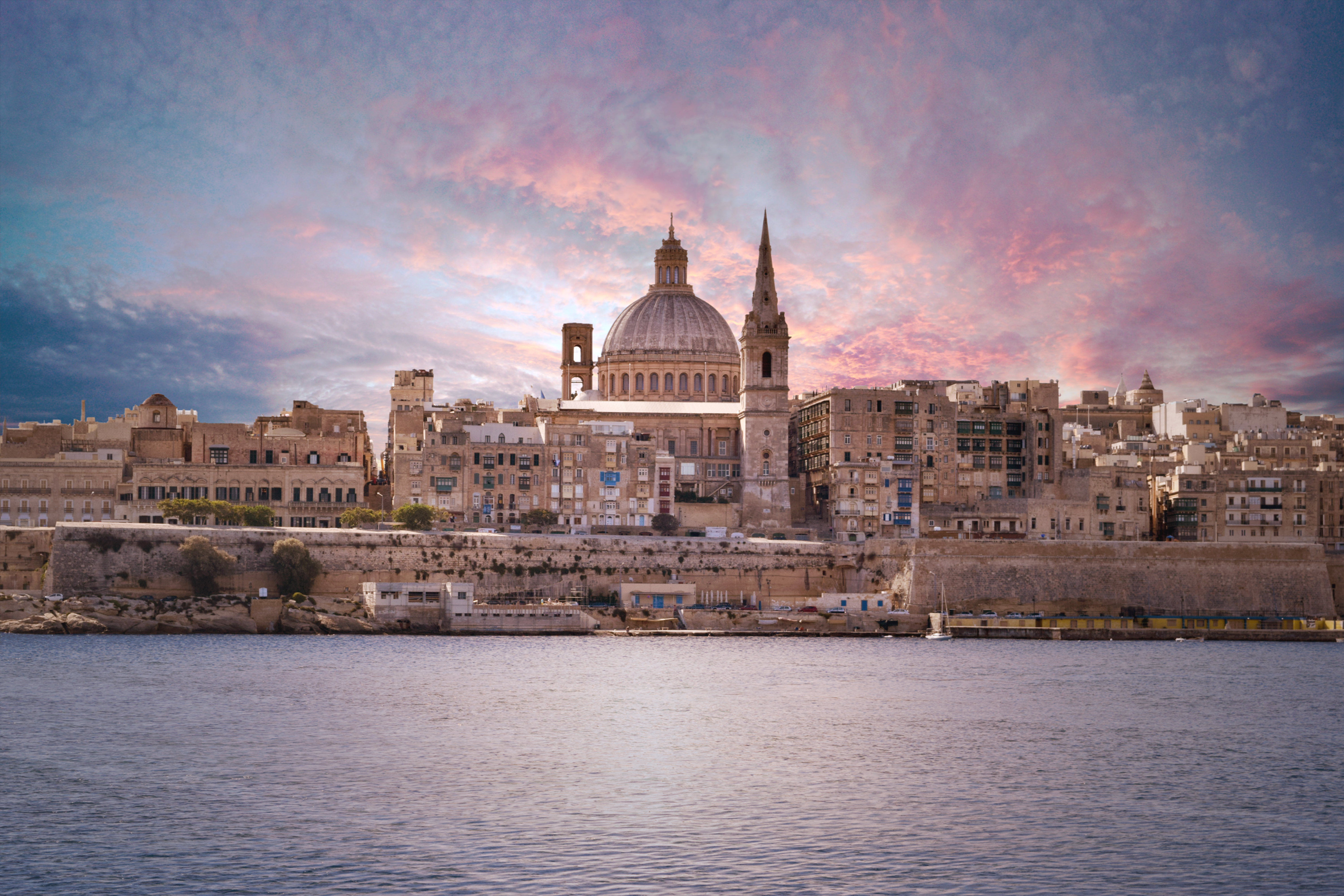
her stay on Malta to recuperate after an illness, the Dowager Queen
Adelaide became the prime mover in arranging for St. Paul’s
Cathedral Church to be built in Valletta. Despite a number of
serious construction problems, that Church was eventually completed and
dedicated for worship in 1844.
Almost immediately, the need for another Church building became
clear. Sliema was very popular amongst British residents, and
Holy Trinity was consecrated in 1867 for them.
The Nave
Look at the stained glass windows near the door. Three of them
fit into the style of the ‘Arts and Crafts’ movement with
which William Morris was associated in Britain in the late 19th
Century. Notice how very different the fourth window looks, can
you work out why?
The impressive marble font stands near the door which used to be the
main way into the Church. Baptism is seen as the first step on
one’s Christian life, so the font is traditionally placed at the
entrance to the Church. Notice here the fine Maltese cross above
the font, given in memory of George Borlase and one of the earliest
memorials in the Church.
Do take some time to look at the other plaques and memorials in the
nave. That for Ethel Winifred Haynes is very striking; the ones
related to the Eastern Telegraph Company remind us of the strategic
importance of Malta and that not all people here were in the armed
services. No one seems to know anything about the
‘Voluntary Workers Corner Club, Sliema,’ which erected the
Second World War plaque at the back of Church; do let us know if you
have any information!
The long list of names on the wooden war memorial reminds us just how
dangerous and difficult life was in Malta during the war period.
These names are read out every year on Remembrance Sunday lest we
forget.
The newest addition inside our Church in the nave is the series of
wooden carvings symbolising the way of the cross. Do take the
time to look closely at some of these before you move up to the Chancel.
The Chancel
The tracery of the wrought iron screen marks the move from nave to
chancel, as do the three steps upwards. Again the symbolism is
important; as we draw closer to God we climb higher. Although the
Church is very plain in many ways, the need to use concrete symbols to
express spiritual ideas is stilt very clear. So the choir stalls
face inwards, the choir members are not giving a concert facing the
audience, but leading the worship.
The organ is here too, for in our way of worshipping music and singing
is very important. We do have services which are said, but mostly
we would involve everyone in singing hymns of praise.
Probably when it was built, the altar in this Church would have been
against the far wall, with the priest leading the service with his back
to the congregation. In that approach, the priest stands in front
of the people and represents them to God. Nowadays most churches
like this one think of God as in the midst of us, and therefore the
priest stands on the far side of the altar facing the people where we
are gathered round the table as God’s family sharing in the
Eucharist.
Take time to absorb the impact of the three windows; this Church is dedicated to the Holy Trinity.
Outside the Church
Here you will find our most recent addition, or rather a renewed original.
As you go through the gates between Bishop’s House and the church
and follow the signs, down the steps to the Church Hall, you will pass
the old cross which can be seen is considerably weather-beaten.
The small garden plots alongside the steps have been transformed over
the recent years from bare earth and stones into separate
gardens. These gardens have been designed, planted and maintained
by individual and family members of the congregation. The last
garden on the right nearest the Hall, is the Sunday School garden,
hence to ornaments which surround it.
The Church today
The Anglican Chaplaincy in Malta and Gozo provides frequent services
here and throughout the islands. The two chaplains respond to the
needs of all who would request their help; the British community,
tourists and many other nationalities. The Chaplaincy has to be
self-supporting. It receives no assistance from abroad and relies
on the donations it receives to cover its costs. It is part of
the Diocese in Europe and the world-wide Anglican Church. It does
not seek to convert from other religions, but to provide Christian
pastoral care and support.
Fr Jeff Williams April 2010
DONATIONS
Brass eagle in 1891.
Font in 1898.
Chancel screen in 1891.
Organ chamber in 1934.
Oak panelling in the nave in 1915.
Pastoral Staff in 1921
Henry Joseph Corbett Knight, the 6th Bishop of Gibraltar, Fellow of the
College of Corpus Christi and the Blessed Virgin Mary of Cambridge
received a gift of a Pastoral Staff from the Master, Fellows and Friends
in Our Lord on the Festival of St James in the year of our Salvation
1911. Subsequently, in 1921 Bishop Knight bequeathed the Staff to Holy Trinity Church, Sliema, Malta.
In 2002 the 16th Bishop of Gibraltar in Europe: Geoffrey Rowell,
himself a former member of Corpus Christi College,
requested that the Chaplaincy council allow him to use the Crozier in
his Episcopal duties around the Diocese, and in January 2003 it was
agreed that he could have it on loan, but that it should remain the
property of, and be
returned to, Holy Trinity Church, Sliema, Malta when he ceases to be
the
Bishop of Gibraltar in Europe.
Those who died defending Malta during the Second World War are
commemorated in a number of ways. The St George window in the northwest
corner of the nave is dedicated to the memory of the worshippers in
this Church, members of HM Forces and Civilians who lost their lives
through enemy action 1939 – 1945.
On the west wall is a brass plate in memory of those who were lost, and
to the right of the Chancel steps is a memorial to the men who served
and fell defending the Island in the 10th Heavy Anti-Aircraft
Regiment, Royal Artillery.
A more detailed guidebook, compiled by Margaret Weaver, can be obtained by e-mail from anglican@onvol.net
Price, including postage and packing, is £3.00 sterling.
|
|